


No help, full refund
Our company is committed to help all of our customers to pass SPSS IBMSPSSSTATL1P as well as obtaining the IT certification successfully, but if you fail exam unfortunately, we will promise you full refund on condition that you show your failed report card to us. In the matter of fact, from the feedbacks of our customers the pass rate has reached 98% to 100%, so you really don't need to worry about that. Our IBMSPSSSTATL1P exam simulation: IBM SPSS Statistics Certification Level 1 (formerly PASW Statistics) sell well in many countries and enjoy high reputation in the world market, so you have every reason to believe that our IBMSPSSSTATL1P study guide materials will help you a lot.
We believe that you can tell from our attitudes towards full refund that how confident we are about our products. Therefore, there will be no risk of your property for you to choose our IBMSPSSSTATL1P exam simulation: IBM SPSS Statistics Certification Level 1 (formerly PASW Statistics), and our company will definitely guarantee your success as long as you practice all of the questions in our IBMSPSSSTATL1P study guide materials. Facts speak louder than words, our exam preparations are really worth of your attention, you might as well have a try.
After purchase, Instant Download: Upon successful payment, Our systems will automatically send the product you have purchased to your mailbox by email. (If not received within 12 hours, please contact us. Note: don't forget to check your spam.)
Free demo before buying
We are so proud of high quality of our IBMSPSSSTATL1P exam simulation: IBM SPSS Statistics Certification Level 1 (formerly PASW Statistics), and we would like to invite you to have a try, so please feel free to download the free demo in the website, we firmly believe that you will be attracted by the useful contents in our IBMSPSSSTATL1P study guide materials. There are all essences for the IT exam in our IBM SPSS Statistics Certification Level 1 (formerly PASW Statistics) exam questions, which can definitely help you to passed the IT exam and get the IT certification easily.
Convenience for reading and printing
In our website, there are three versions of IBMSPSSSTATL1P exam simulation: IBM SPSS Statistics Certification Level 1 (formerly PASW Statistics) for you to choose from namely, PDF Version, PC version and APP version, you can choose to download any one of IBMSPSSSTATL1P study guide materials as you like. Just as you know, the PDF version is convenient for you to read and print, since all of the useful study resources for IT exam are included in our IBM SPSS Statistics Certification Level 1 (formerly PASW Statistics) exam preparation, we ensure that you can pass the IT exam and get the IT certification successfully with the help of our IBMSPSSSTATL1P practice questions.
Under the situation of economic globalization, it is no denying that the competition among all kinds of industries have become increasingly intensified (IBMSPSSSTATL1P exam simulation: IBM SPSS Statistics Certification Level 1 (formerly PASW Statistics)), especially the IT industry, there are more and more IT workers all over the world, and the professional knowledge of IT industry is changing with each passing day. Under the circumstances, it is really necessary for you to take part in the SPSS IBMSPSSSTATL1P exam and try your best to get the IT certification, but there are only a few study materials for the IT exam, which makes the exam much harder for IT workers. Now, here comes the good news for you. Our company has committed to compile the IBMSPSSSTATL1P study guide materials for IT workers during the 10 years, and we have achieved a lot, we are happy to share our fruits with you in here.

SPSS IBMSPSSSTATL1P Exam Syllabus Topics:
| Section | Weight | Objectives |
|---|---|---|
| Operations / Running IBM SPSS Statistics | 15% | - Software settings and preferences - General interface and navigation - Syntax editor and command usage |
| Data Transformations | 16% | - Counting values across variables/cases - Computing and recoding variables - Creating categorical variables - Conditional operations |
| Basic Inferential Statistics | 22% | - T-tests and sample analysis - Chi-square tests - Linear regression - Statistical error and interpretation - Correlation analysis |
| Reading and Defining Data | 16% | - Handling data types and formats - Defining variable properties - Importing and reading datasets |
| Data Understanding / Descriptives | 9% | - Means and summary procedures - Crosstabs and dispersion measures - Frequencies and descriptive statistics |
| Output: Editing and Exploring | 7% | - Creating and editing charts - Pivot tables and output management - Exporting results and OMS usage |
| Data Management | 15% | - Identifying and removing duplicates - Selecting and splitting files - Adding and aggregating cases |
SPSS IBM SPSS Statistics Certification Level 1 (formerly PASW Statistics) Sample Questions:
1. Which interpretation is correct for the Correlations table?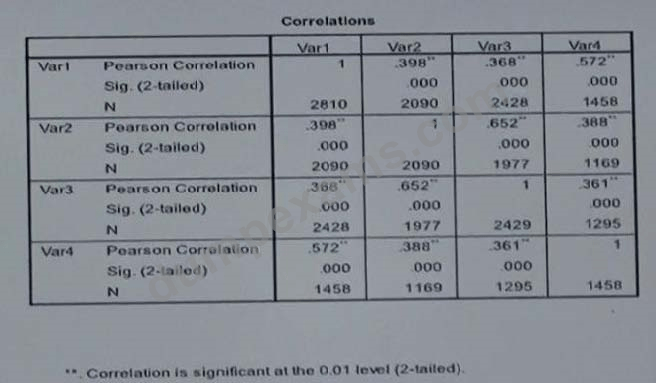
A) All of these correlations are statistically are significantly and the strongest correlations is between Var1 and Var4.
B) None of these correlations are statistically are significantly and the strongest correlations is between Var2 and Var3.
C) None of these correlations are statistically are significantly and the strongest correlations is between Var1 and Var4.
D) All of these correlations are statistically are significantly and the strongest correlations is between Var2 and Var3.
2. In the Variable View, if you have a series of variables that share the same category coding scheme, you can enter value labels for one variable, then copy these variables.
A) True
B) False
3. Which Pivoting Tray corresponds to the illustrated cross tabulation?

A) Exhibit A
B) Exhibit B
C) Exhibit C
D) Exhibit D
4. If you use the IBM SPSS Statistics Select Cases dialog to conduct analysis on a subset of cases and you want to keep all cases in the same dataset. Which option is appropriate?
A) Filter out unselected cases
B) Copy selected cases to a new dataset
C) Copy unselected cases to a new dataset
D) Delete unselected cases
5. If you request an aggregate dataset or data file in the Aggregate procedure, the number of cases in the new aggregated file is equal to what?
A) Number of aggregated summary variables.
B) Number of categories of the variables specified in the Break Variables list
C) Number of cases in the original data file.
D) Number of cases that you specified in the Aggregate Data dialogue box
Solutions:
| Question # 1 Answer: C | Question # 2 Answer: A | Question # 3 Answer: B | Question # 4 Answer: B | Question # 5 Answer: C |


