


[Sep 16, 2025] Pass JN0-683 Review Guide, Reliable JN0-683 Test Engine
JN0-683 Test Engine Practice Test Questions, Exam Dumps
NEW QUESTION # 35
You are deploying an IP fabric using EBGP and notice that your leaf devices areadvertising and receiving all the routes. However, the routes are not installed in the routing table and are marked as hidden.
Which two statements describe how to solve the issue? (Choose two.)
- A. You need to configure multipath multiple-as.
- B. You need to configure loops 2.
- C. You need to configure a next-hop self policy.
- D. You need to configure as-override.
Answer: A,C
Explanation:
* Issue Overview:
* The leaf devices in an IP fabric using eBGP are advertising and receiving all routes, but the routes are not being installed in the routing table and are marked as hidden. Thistypically indicates an issue with the BGP configuration, particularly with next-hop handling or AS path concerns.
* Corrective Actions:
* B. You need to configure a next-hop self policy:This action ensures that the leaf devices modify the next-hop attribute to their own IP address before advertising routes to their peers. This is particularly important in eBGP setups where the next-hop may not be directly reachable by other peers.
* D. You need to configure multipath multiple-as:This setting allows the router to accept multiple paths from different autonomous systems (ASes) and use them for load balancing.
Without this, the BGP process might consider only one path and mark others as hidden.
* Incorrect Statements:
* A. You need to configure as-override:AS-override is used to replace the AS number in the AS- path attribute to prevent loop detection issues in MPLS VPNs, not in a typical eBGP IP fabric setup.
* C. You need to configure loops 2:There is no specific BGP command loops 2 relevant to resolving hidden routes in this context. It might be confused with allowas-in, which is used to allow AS path loops under certain conditions.
Data Center References:
* Proper BGP configuration is crucial in IP fabrics to ensure route propagation and to prevent routes from being marked as hidden. Configuration parameters like next-hop self and multipath multiple-as are common solutions to ensure optimal route installation and load balancing in a multi-vendor environment.
NEW QUESTION # 36
Exhibit.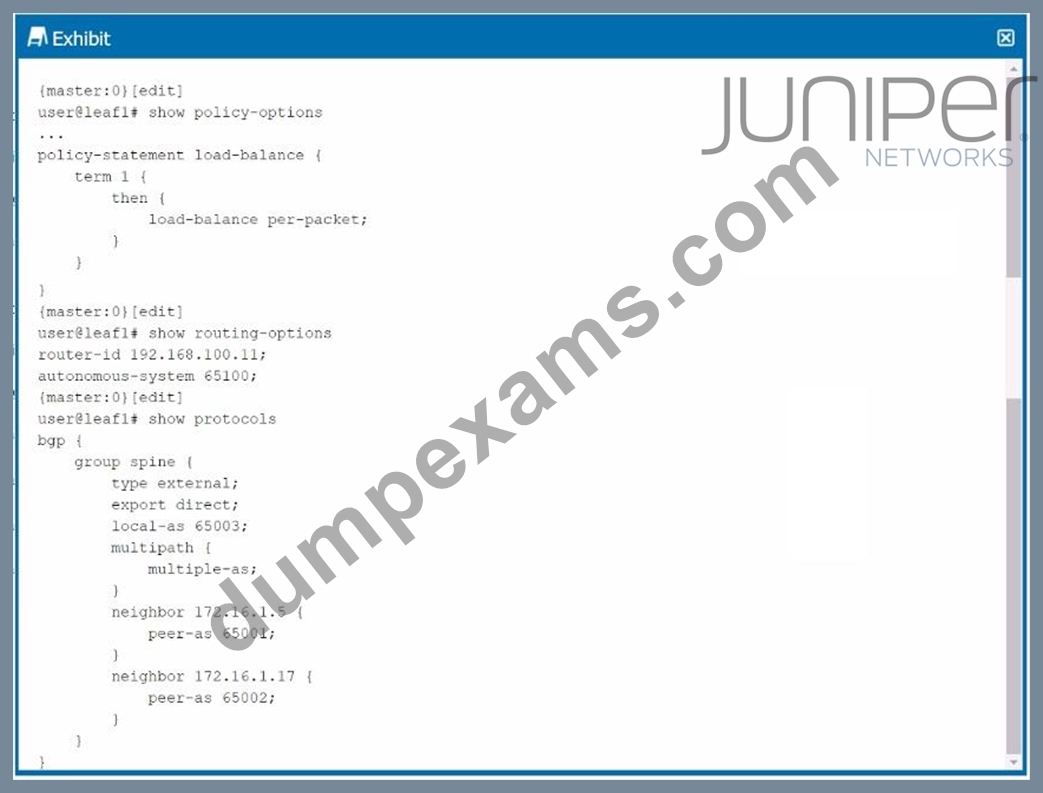
You are troubleshooting an IP fabric (or your data center. You notice that your traffic is not being load balanced to your spine devices from your leaf devices. Referring to the configuration shown in the exhibit, what must be configured to solve this issue?
- A. The load-balance policy must be applied as an export policy to your BGP
- B. The load-balance policy must be applied to the forwarding table under the routing-options hierarchy.
- C. The multipastmultiple -as configuration must be configured for each peer in the BGP spine group.
- D. The load-balance policy must have a from statement that matches on protocol bgp.
Answer: C
Explanation:
* IP Fabric Load Balancing:
* In the provided configuration, traffic is not being load-balanced to the spine devices. The issue likely relates to how BGP routes are being selected and whether Equal-Cost Multi-Path (ECMP) is functioning correctly.
* Multipath Multiple-AS:
* Option B:The multipath multiple-as configuration is essential when using BGP in an IP fabric where devices belong to different Autonomous Systems (AS). This setting allows BGP to consider multiple paths (even across different AS numbers) as equal cost, enabling ECMP and proper load balancing across spine devices.
Conclusion:
* Option B:Correct-The multipath multiple-as configuration is necessary for achieving ECMP and effective load balancing in a multi-AS BGP environment.
NEW QUESTION # 37
Exhibit.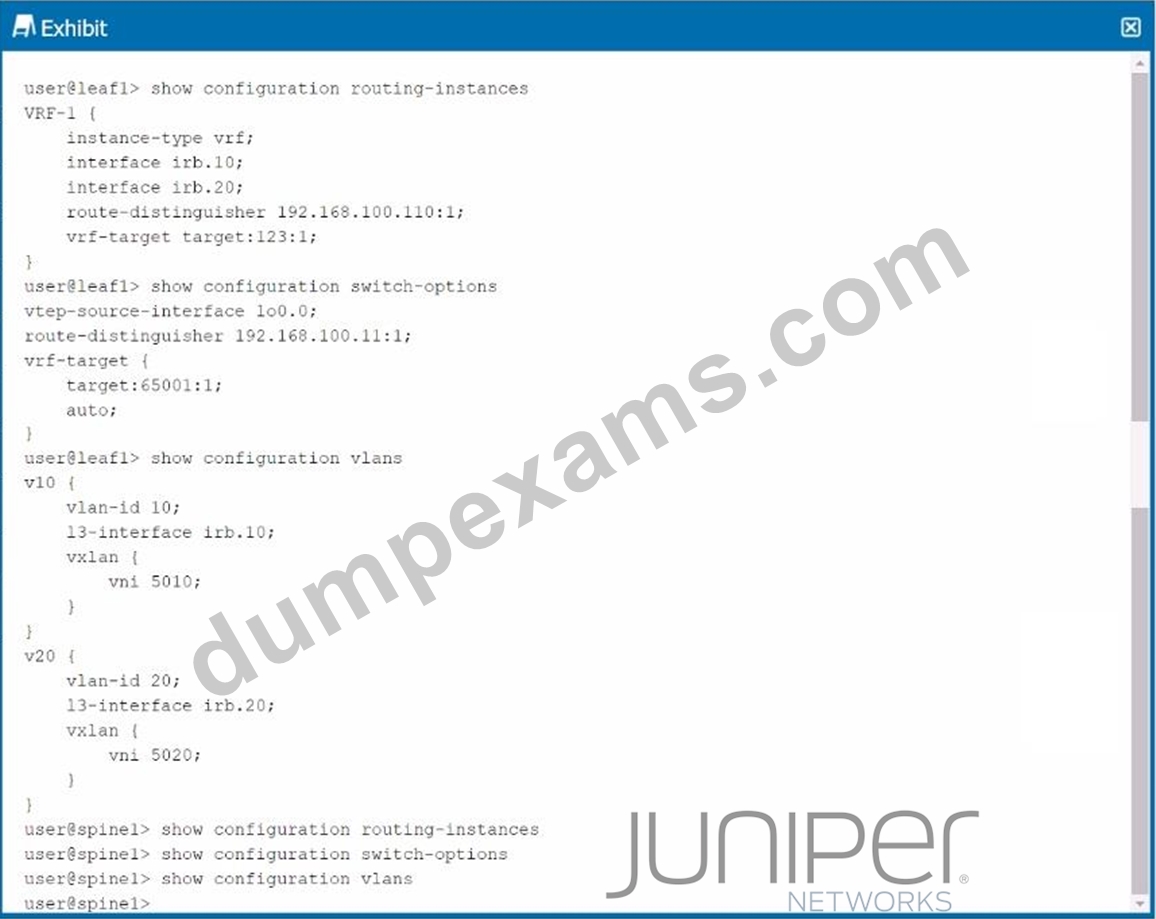
Referring to the exhibit, which statement Is true?
- A. An OTT architecture is being used.
- B. A CRB architecture is being used.
- C. A PBB-EVPN architecture is being used.
- D. An ERB architecture is being used.
Answer: D
Explanation:
* Understanding Network Architectures:
* ERB (Edge Routed Bridging) architecture involves routing at the network's edge (leaf nodes), while traffic between leaf nodes is switched. This is commonly used in VXLAN-EVPN setups.
* Analysis of the Exhibit:
* The exhibit shows configurations related to routing instances, VXLAN, and VLANs, with VNIs being used for each VLAN. This setup is characteristic of an ERB architecture where each leaf device handles Layer 3 routing for its connected devices.
Conclusion:
* Option B:Correct-The configuration shown corresponds to an ERB architecture where routing occurs at the network's edge (leaf devices).
NEW QUESTION # 38
Exhibit.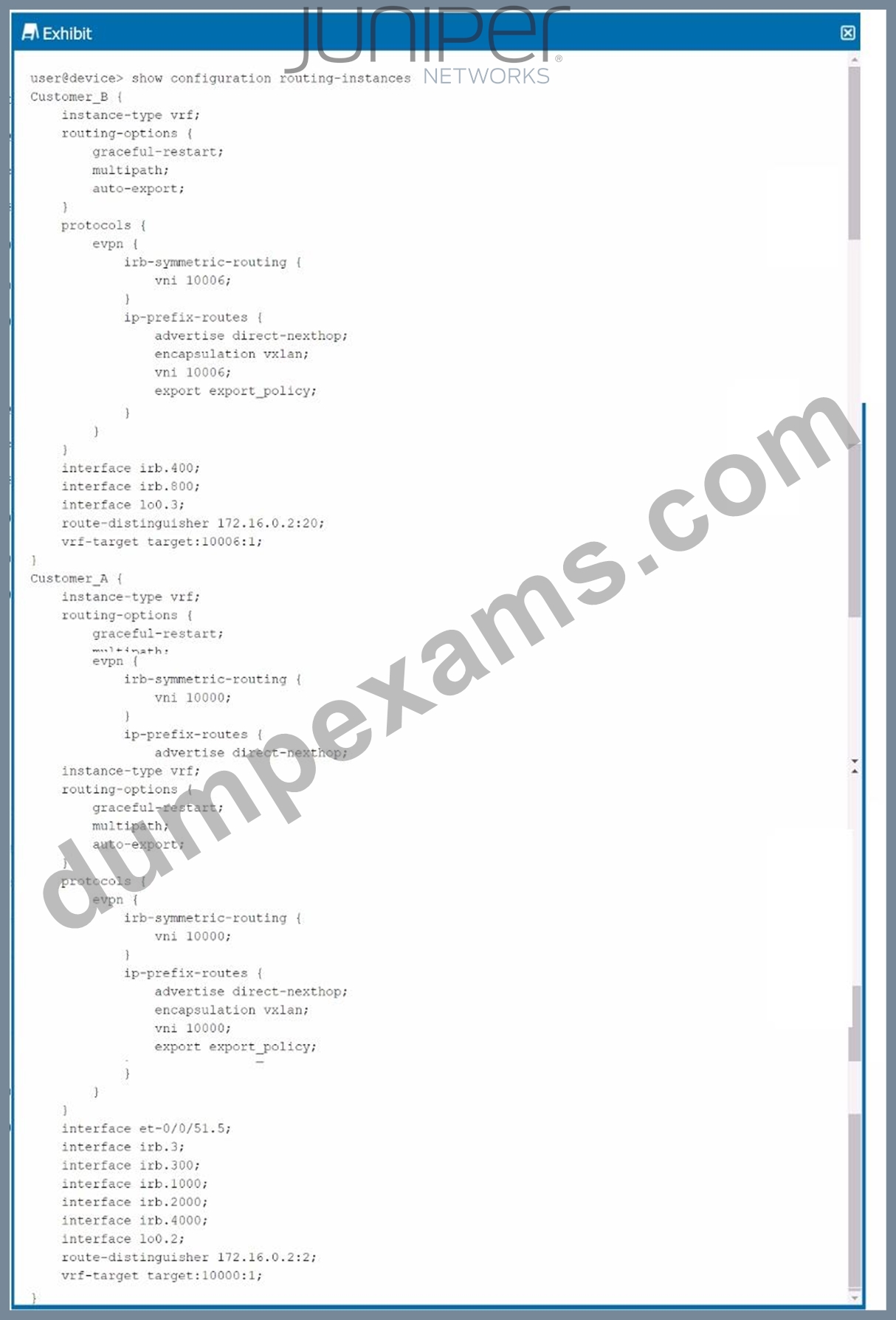
Referring to the configuration shown in the exhibit, assume that there is no external router present, and that the configuration is fabric-only.
Which two statements are true about the example configuration? (Choose two.)
- A. Devices in irb.400 (vlan 400) are not able to communicate directly with devices in routing instance Customer A.
- B. Devices in irb.400 (vlan 400) and irb.800 (vlan 800) are able to communicate over the fabric.
- C. Devices in routing instance Customer A are able to communicate with devices in routing instance Customer B
- D. VNI 10006is assigned to vlan 800 (irb.800).
Answer: A,B
Explanation:
* Understanding the Configuration:
* The exhibit shows configurations for two VRFs (Customer_A and Customer_B) with specific VLANs and VNIs assigned. Each VRF has interfaces (IRBs) associated with particular VLANs.
* Communication Between VLANs and Routing Instances:
* Option B:VLAN 400 (irb.400) is part of Customer_B, and there is no direct connection or routing between Customer_A and Customer_B in the configuration provided. Therefore, devices in irb.400 cannot communicate directly with devices in the Customer_A routing instance.
* Option D:Since irb.400 (VLAN 400) and irb.800 (VLAN 800) are part of the same routing instance (Customer_B), they can communicate over the fabric using VXLAN encapsulation.
Conclusion:
* Option B:Correct-There is no direct communication between devices in irb.400 (Customer_B) and routing instance Customer_A.
* Option D:Correct-Devices in VLAN 400 and VLAN 800 can communicate within the Customer_B routing instance over the fabric.
NEW QUESTION # 39
Exhibit.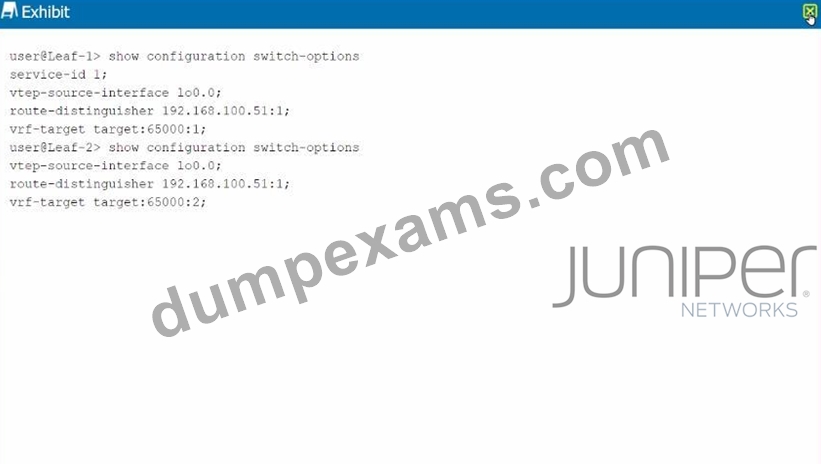
Connections between hosts connected to Leaf-1 and Leaf-2 are not working correctly.
- A. Referring to the exhibit, which two configuration changes are required to solve the problem? (Choose two.)
- B. Configure the setswitch-options service-id 1 parameter on Leaf-2.
- C. Configure the set switch-options vrf-target target:65000:l parameteron Leaf-2.
- D. Configure the setswitch-options route-distinguisher i92.168.100.50:i parameter on Leaf-1.
- E. Configure the setswitch-options vtep-source-interface irb.0parameter on Leaf-1.
Answer: B,C
Explanation:
* Issue Analysis:
* The problem in the exhibit suggests a mismatch in configuration parameters between Leaf-1 and Leaf-2, leading to communication issues between hosts connected to these leaf devices.
* Configuration Mismatches:
* Service-ID:Leaf-1 has service-id 1 configured, while Leaf-2 does not have this parameter. For consistency and proper operation, the service-id should be the same across both leaf devices.
* VRF Target:Leaf-1 is configured with vrf-target target:65000:1, while Leaf-2 is configured with vrf-target target:65000:2. To allow proper VRF import/export between the two leafs, these should match.
* Corrective Actions:
* C. Configure the set switch-options vrf-target target:65000:1 parameter on Leaf-2:This aligns the VRF targets between the two leaf devices, ensuring they can correctly import and export routes.
* E. Configure the set switch-options service-id 1 parameter on Leaf-2:This ensures that both Leaf-1 and Leaf-2 use the same service ID, which is necessary for consistency in the EVPN- VXLAN setup.
Data Center References:
* Correct configuration of VRF targets and service IDs is critical in EVPN-VXLAN setups to ensure that routes and services are correctly shared and recognized between different devices in the network fabric.
NEW QUESTION # 40
You want to ensure thatVXLAN traffic from the xe-0/0/12 interlace is being encapsulatedby logical vlep.
32770 and sent to a remote leaf device in this scenario, which command would you use to verify that traffic is flowing?
- A. show interfaces terse vtep.32770 statistics
- B. show interface terse vtep.32770
- C. show interfaces vtep.32770 detail
- D. monitor traffic interface xe-0/0/12
Answer: A
Explanation:
* VXLAN Traffic Verification:
* To ensure VXLAN traffic from the xe-0/0/12 interface is correctly encapsulated by the logical vtep.32770 and sent to a remote leaf device, it is essential to monitor the relevant interface statistics.
* The command show interfaces terse vtep.32770 statistics provides a concise overview of the traffic statistics for the specific VTEP interface, which can help verify whether traffic is being correctly encapsulated and transmitted.
* Explanation:
* This command is particularly useful for quickly checking the traffic counters and identifying any potential issues with VXLAN encapsulation or transmission.
* It allows you to confirm that traffic is flowing as expected, by checking the transmitted and received packet counters.
Data Center References:
* Monitoring interface statistics is a crucial step in troubleshooting and validating network traffic, particularly in complex overlay environments like EVPN-VXLAN.
NEW QUESTION # 41
You want to convert an MX Series router from a VXLAN Layer 2 gateway to a VXLAN Layer 3 gateway for VNI 100. You have already configured an IRB interface. In this scenario, which command would you use to accomplish this task?
- A. set protocols ospf area 0.0.0.0 interface irb.100 passive
- B. set protocols isis interface irb.100 passive
- C. set vlans VLAN-100 13-interface irb.100
- D. set bridge-domains VLAN-100 routing-interface irb.100
Answer: D
NEW QUESTION # 42
Exhibit.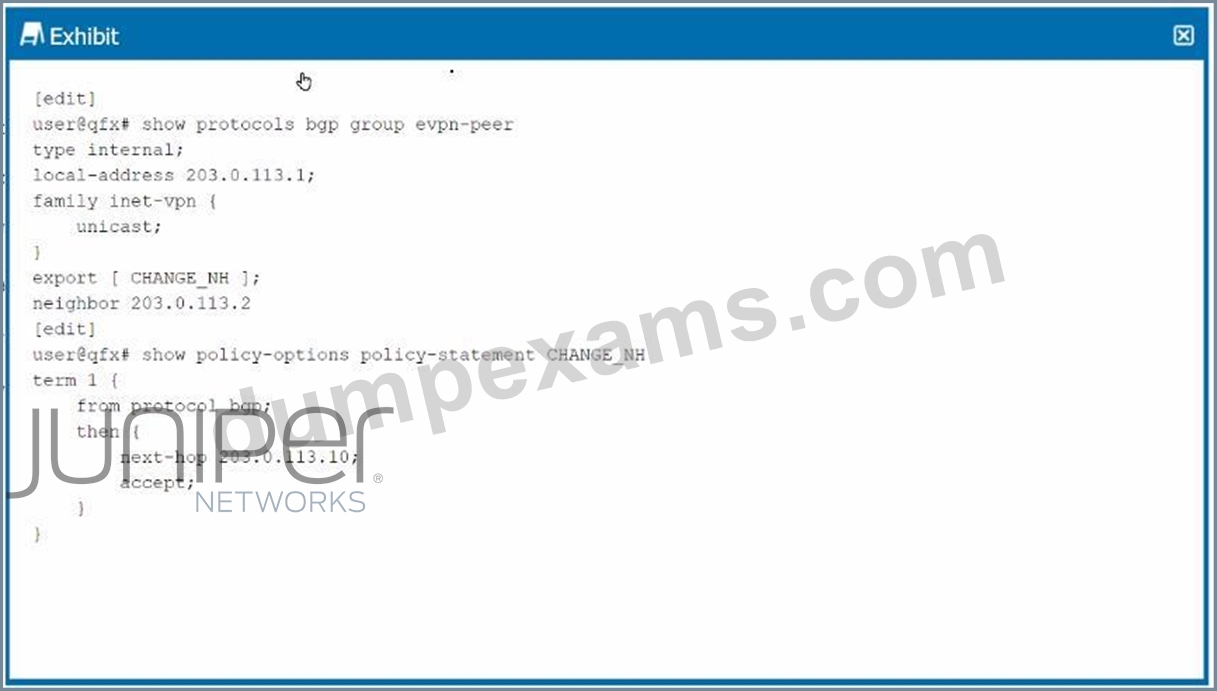
Given the configuration shown in the exhibit, why has the next hop remained the same for the EVPN routes advertised to the peer 203.0.113.2?
- A. EVPN routes cannot have the next hop changed.
- B. The vpn-apply-export parameter must be applied to this peer.
- C. The export policy is incorrectly configured.
- D. The vrf-export parameter must be applied.
Answer: B
Explanation:
* Understanding the Configuration:
* The configuration shown in the exhibit involves an EVPN (Ethernet VPN) setup using BGP as the routing protocol. The export policy named CHANGE_NH is applied to the BGP group evpn- peer, which includes a rule to change the next hop for routes that match the policy.
* Issue with Next Hop Not Changing:
* The policy CHANGE_NH is correctly configured to change the next hop to 203.0.113.10 for the matching routes. However, the next hop remains unchanged when advertising EVPN routes to the peer 203.0.113.2.
* Reason for the Issue:
* In Junos OS, when exporting routes for VPNs (including EVPN), the next-hop change defined in a policy will not take effect unless the vpn-apply-export parameter is used inthe BGP configuration. This parameter ensures that the export policy is applied specifically to VPN routes.
* The vpn-apply-export parameter must be included to apply the next-hop change to EVPN routes.
* Correct Answer Explanation:
* D. The vpn-apply-export parameter must be applied to this peer:This is the correct solution because the next hop in EVPN routes won't be altered without this parameter in the BGP configuration. It instructs the BGP process to apply the export policy to the EVPN routes.
Data Center References:
* This behavior is standard in EVPN deployments with Juniper Networks devices, where the export policies applied to VPN routes require explicit invocation using vpn-apply-export to take effect.
NEW QUESTION # 43
Exhibit.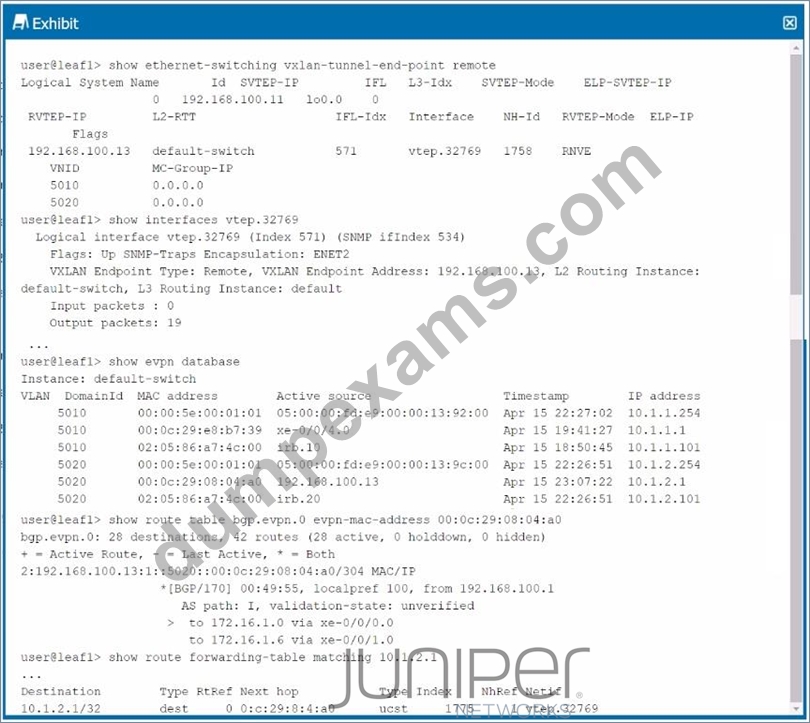
Referring to the exhibit, Host1 (10.1.1.1) is failing to communicate with Host2 (10.1.2.1) in a data center that uses an ERB architecture. What do you determine from the output?
- A. Host1 and Host2 are directly connected to leaf1.
- B. The traffic is failing because load balancing is not configured correctly.
- C. The irb.20 interface is not configured on leaf1.
- D. The traffic is entering the VXLAN tunnel.
Answer: D
Explanation:
Understanding the Problem:
* Host1 (10.1.1.1) is failing to communicate with Host2 (10.1.2.1) within an EVPN-VXLAN environment using ERB architecture.
Analysis of the Exhibit:
* The provided output includes information from the show route forwarding-table matching command for IP 10.1.2.1. The next hop is shown as vtep.32769, which indicates that the traffic destined for 10.1.2.1 is being forwarded into the VXLAN tunnel with the correct VTEP (VXLAN Tunnel Endpoint).
Conclusion:
* Option B:Correct-The traffic from Host1 is entering the VXLAN tunnel, as evidenced by the next hop pointing to a VTEP. However, the issue could lie elsewhere, possibly with the remote VTEP, routing configurations, or the receiving leaf/spine devices.
NEW QUESTION # 44
You want to provide a OCI that keeps each data center routing domain isolated, while also supporting translation of VNIs. Which DCI scheme allows these features?
- A. over the top (OTT) with proxy gateways
- B. MPLS DCI label exchange
- C. VXLAN stitching
- D. over the top (OTT) with VNI translation enabled
Answer: C
Explanation:
* Understanding DCI (Data Center Interconnect) Schemes:
* DCI schemes are used to connect multiple data centers, enabling seamless communication and resource sharing between them. The choice of DCI depends on the specific requirements, such as isolation, VNI translation, or routing domain separation.
* VXLAN Stitching:
* VXLAN stitching involves connecting multiple VXLAN segments, allowing VNIs (VXLAN Network Identifiers) from different segments to communicate with each other while maintaining separate routing domains.
* This approach is particularly effective for keeping routing domains isolated while supporting VNI translation, making it ideal for scenarios where you need to connect different data centers or networks without merging their control planes.
* Other Options:
* A. MPLS DCI label exchange:This option typically focuses on MPLS-based interconnections and does not inherently support VNI translation or isolation in the context of VXLAN.
* B. Over the top (OTT) with VNI translation enabled:This could support VNI translation but does not inherently ensure routing domain isolation.
* D. Over the top (OTT) with proxy gateways:This typically involves using external gateways for traffic routing and may not directly support VNI translation or isolation in the same way as VXLAN stitching.
Data Center References:
* VXLAN stitching is a powerful method in multi-data center environments, allowing for flexibility in connecting various VXLAN segments while preserving network isolation and supporting complex interconnect requirements.
NEW QUESTION # 45
You manage an IP fabric with an EVPN-VXLAN overlay. You have multiple tenants separated using multiple unique VRF instances. You want to determine the routing information that belongs in each routing instance's routing table.
In this scenario, which property is used for this purpose?
- A. the VRF table label
- B. the routing instance type
- C. the VRF target community
- D. the route distinguisher value
Answer: D
Explanation:
* Understanding VRF and Routing Instances:
* In an EVPN-VXLAN overlay network, multiple tenants are separated using unique VRF (Virtual Routing and Forwarding) instances. Each VRF instance maintains its own routing table, allowing for isolated routing domains within the same network infrastructure.
* Role of Route Distinguisher:
* Route Distinguisher (RD):The RD is a unique identifier used in MPLS and EVPN environments to distinguish routes belonging to different VRFs. The RD is prepended to the IP address in the route advertisement, ensuring that routes from different tenants remain unique even if they use the same IP address range.
* Correct Property:
* D. the route distinguisher value:This is the correct answer because the RD is crucial in determining which routing information belongs to which VRF instance. It ensures that each VRF' s routing table only contains relevant routes, maintaining isolation between tenants.
Data Center References:
* The RD is a key element in MPLS and EVPN-based multi-tenant environments, ensuring proper routing segregation and isolation for different VRFs within the data center fabric.
NEW QUESTION # 46
You are asked to implement VXLAN group-based policies (GBPs) in your data center. Which two statements are correct in (his scenario? (Choose two.)
- A. VXLAN GBP uses scalable group tags thatmust be configured statically on each switch and activated through 802.1X.
- B. VXLAN GBP uses scalable group tags that may be configured on a RADIUS server and pushed to the switch through 802.1X.
- C. VXLAN GBP ensures consistent application of security group policies throughout the network.
- D. VXLAN GBP ensures consistent application of BGP groups throughout the network.
Answer: B,C
Explanation:
* VXLAN Group-Based Policies (GBP):
* VXLAN Group-Based Policies are used to apply security policies consistently across the network. These policies are often tied to user or device identities rather than static IP addresses, which allows for more dynamic and scalable security management.
* Scalable Group Tags via RADIUS and 802.1X:
* Option B:VXLAN GBP can use scalable group tags configured on a RADIUS server, which are then pushed to network devices through 802.1X. This allows for centralized and automated policy application based on user or device identity.
* Consistent Security Policy Application:
* Option C:GBP ensures that security policies are consistently applied across the network, regardless of where a user or device connects. This consistency is crucial in environments where security policies must follow the user or device.
Conclusion:
* Option B:Correct-Group tags can be configured on a RADIUS server and pushed via 802.1X, enabling centralized policy management.
* Option C:Correct-GBP ensures consistent application of security policies, which is essential for maintaining security across a dynamic network environment.
NEW QUESTION # 47
You are implementing seamless stitching between two data centers and have a proposedconfiguration for a border leafdevice.
In this scenario, which two statements are correct? {Choose two.)
- A. The translation-vni must be different in each data center.
- B. The ESI must be different in each data center.
- C. The translation-vni must match in both data centers.
- D. The ESI must match in both data centers.
Answer: A,D
Explanation:
* Understanding Seamless Stitching:
* Seamless stitching is used in EVPN to interconnect two data centers, allowing for consistent Layer 2 and Layer 3 connectivity across them. This is often achieved by translating VNIs (Virtual Network Identifiers) between the data centers.
* Translation-VNI:
* Option B:The translation VNI must be different in each data center to ensure that traffic can be correctly routed and distinguished as it crosses between the data centers. This differentiation helps to maintain the integrity of the traffic flows and prevents any potential overlap or conflict in VNIs.
* Ethernet Segment Identifier (ESI):
* Option D:The ESI must match in both data centers to ensure that the same Ethernet segment (which could be multihomed) is recognized consistently across the data centers. Matching ESIs are crucial for maintaining a unified view of the Ethernet segment across the interconnected fabric.
Conclusion:
* Option B:Correct-Translation VNIs must be unique to each data center for proper traffic distinction.
* Option D:Correct-Matching ESIs are necessary to maintain consistent Ethernet segment identification across both data centers.
NEW QUESTION # 48
Exhibit.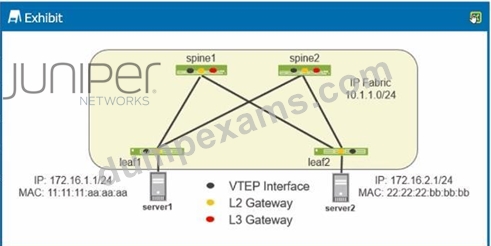
You have implemented an EVPN-VXLAN data center. Device served must be able to communicate with device server2.
Referring to the exhibit, which two statements are correct? (Choose two.)
- A. Traffic from server1 to server2 will transit a VXLAN tunnel to spinel or spine2. then a VXLAN tunnel from spinel or spine2 to Ieaf2.
- B. An IRB interface must be configured on spine1and spine2.
- C. Traffic from server! to server2 will transit the VXLAN tunnel between leaf1 and Ieaf2.
- D. An IRB Interface must be configured on leaf1 and Ieaf2.
Answer: A,B
NEW QUESTION # 49
Exhibit.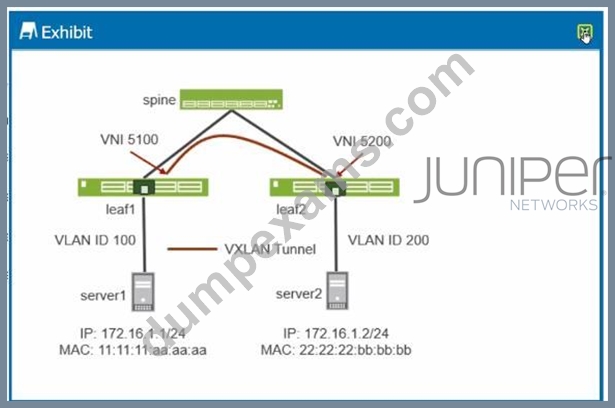
A VXLAN tunnel has been created between leaf1 and Ieaf2 in your data center. Referring to the exhibit, which statement is correct?
- A. Traffic sent from server1 to server2 will be tagged with VLAN ID 100 on Ieaf2 and forwarded to server2.
- B. Traffic sent from server1 to server2 will be dropped on leaf1.
- C. Traffic sent from server1 to server2 will be dropped on Ieaf2.
- D. Traffic sent from server1 to server2 will be tagged with VLAN ID 200 on Ieaf2 and forwarded to server2.
Answer: B
NEW QUESTION # 50
Exhibit.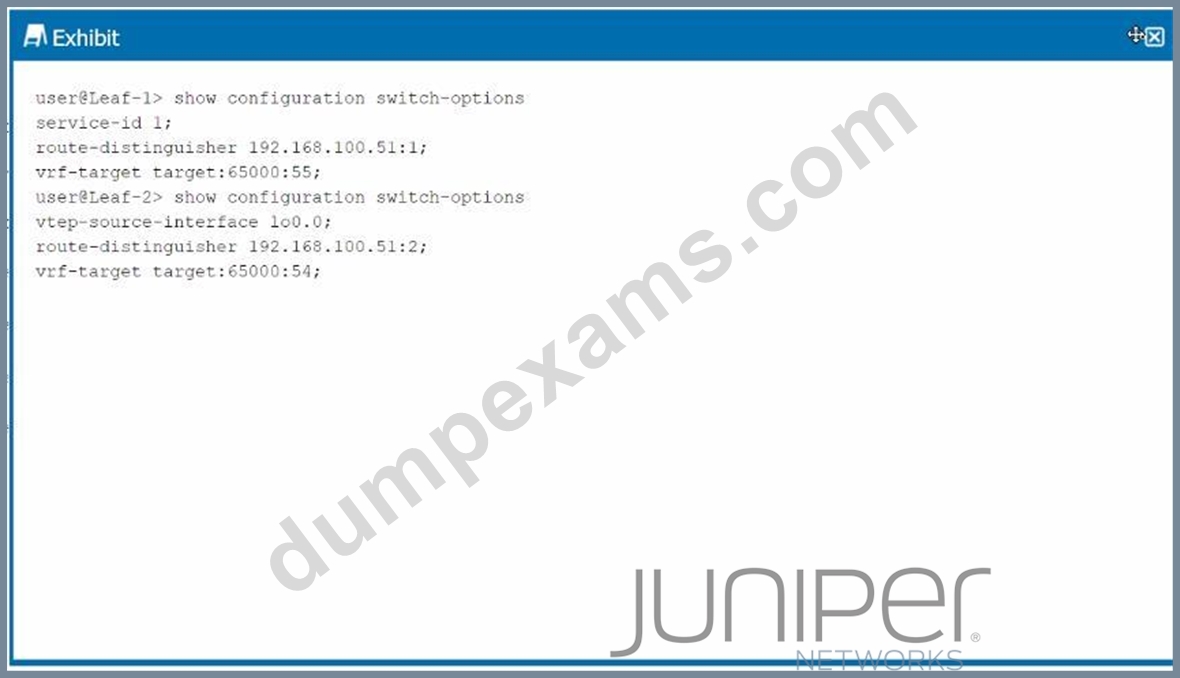
Connections between hosts connected to Leaf-1 and Leaf-2 are not working correctly.
Referring to the exhibit, which two configuration changes are required to solve the problem? (Choose two.)
- A. Configure the set switch-options service-id 1 parameter on Leaf-2.
- B. Configure the set switch-options vrf-target target: 65000:55 parameter on Leaf-2.
- C. Configure the setswitch-options route-distinguisher 192.168.100.51:2 parameter on Leaf-1.
- D. Configure the setswitch-options vtep-source-interface100. 0 parameter on Leaf-1.
Answer: A,B
Explanation:
* Review of the Exhibit:
* The exhibit shows the switch configuration for Leaf-1 and Leaf-2. The configurations include route distinguishers, VRF targets, and service IDs, all of which are crucial for ensuring proper operation in an EVPN-VXLAN environment.
* Service-ID Consistency:
* The service ID must be consistent across all participating leaf devices in the same EVPN instance to ensure that they are part of the same VXLAN overlay network.
* VRF Target Consistency:
* The vrf-target parameter must also be consistent across devices to ensure that VRFs (Virtual Routing and Forwarding instances) are correctly imported and exported between leaf nodes.
Conclusion:
* Option B:Correct-Setting the same service-id on Leaf-2 ensures that it is part of the same VXLAN overlay as Leaf-1.
* Option D:Correct-The vrf-target on Leaf-2 should match Leaf-1 to ensure consistent routing policies and proper route exchange.
NEW QUESTION # 51
You are asked to deploy 100 QFX Series devices using ZTP Each OFX5120 requires a different configuration. In this scenario, what are two components that you would configure on the DHCP server?
(Choose two.)
- A. the IP address of the FTP server
- B. the MAC address of the FTP server
- C. the MAC address for each OFX5120
- D. the management IP address for each OFX5120
Answer: C,D
NEW QUESTION # 52
You are deploying an IP fabric with an oversubscription ratio of 3:1.
In this scenario, which two statements are correct? (Choose two.)
- A. The oversubscription ratio increases when you remove leaf devices.
- B. The oversubscription ratio remains the same when you remove leaf devices.
- C. The oversubscription ratio remains the same when you add leaf devices.
- D. The oversubscription ratio decreases when you add leaf devices.
Answer: A,C
Explanation:
* Understanding Oversubscription Ratio in IP Fabrics:
* The oversubscription ratio in an IP fabric typically refers to the ratio of the available bandwidth at the edge of the network (leaves) to the available bandwidth at the core or spine. A 3:1 oversubscription ratio means that for every 3 units of bandwidth at the leaves, there is 1 unit of bandwidth at the spine.
* Impact of Adding or Removing Leaf Devices:
* Removing Leaf Devices:When you remove leaf devices, the amount of total edge bandwidth decreases while the bandwidth in the spine remains constant. This causes the oversubscription ratio toincreasebecause there is now less total bandwidth to distribute across the same amount of spine bandwidth.
* Adding Leaf Devices:Conversely, when you add leaf devices, the total edge bandwidth increases. Since the spine bandwidth remains the same, the oversubscription ratio would remain the same if the additional leaves consume their share of the available bandwidth proportionally.
Conclusion:
* Option C:Correct-Removing leaf devices increases the oversubscription ratio.
* Option D:Correct-Adding leaf devices typically maintains the oversubscription ratio assuming uniform bandwidth distribution.
NEW QUESTION # 53
Whatare two supported methods (or exporting data when using the Junos telemetry interface? (Choose two.)
- A. using SNMP
- B. using gRPC
- C. using REST
- D. using UDP
Answer: B,D
Explanation:
* Junos Telemetry Interface (JTI):
* The Junos Telemetry Interface is a framework that allows network operators to collect real-time telemetry data from Juniper devices. This data can be used for monitoring, analytics, and network automation.
* Data Export Methods:
* Option B:UDP (User Datagram Protocol)is a lightweight, connectionless protocol used for exporting telemetry data quickly with minimal overhead. While it doesn't guarantee delivery, it is suitable for high-speed data transfer where occasional packet loss is acceptable.
* Option D:gRPC (gRPC Remote Procedure Call)is a modern, high-performance method for data export that supports streaming and remote procedure calls, making it ideal for more complex telemetry data use cases.
Conclusion:
* Option B:Correct-UDP is supported for exporting telemetry data.
* Option D:Correct-gRPC is also supported, offering advanced streaming capabilities
NEW QUESTION # 54
......
Juniper JN0-683 Exam Syllabus Topics:
| Topic | Details |
|---|---|
| Topic 1 |
|
| Topic 2 |
|
| Topic 3 |
|
100% Free JN0-683 Daily Practice Exam With 68 Questions: https://prep4sure.dumpexams.com/JN0-683-vce-torrent.html