


100% Pass Guaranteed Accurate AZ-400 Answers 365 Days Free Updates
AZ-400 DUMPS Q&As with Explanations Verified & Correct Answers
NEW QUESTION # 335
You have a build pipeline in Azure Pipelines that uses different jobs to compile an application for 10 different architectures.
The build pipeline takes approximately one day to complete.
You need to reduce the time it takes to execute the build pipeline
Which two actions should you perform? Each correct answer presents part of the solution.
NOTE: Each correct selection is worth one point
- A. Create an agent pool.
- B. Create a deployment group.
- C. Reduce the size of the repository.
- D. Move to a blue/green deployment pattern.
- E. Increase the number of parallel jobs.
Answer: A,E
Explanation:
Question: I need more hosted build resources. What can I do?
answer: The Azure Pipelines pool provides all Azure DevOps organizations with cloud-hosted build agents
and free build minutes each month. If you need more Microsoft-hosted build resources, or need to run more jobs in parallel, then you can either:
Host your own agents on infrastructure that you manage.
Buy additional parallel jobs.
Reference:
https://docs.microsoft.com/en-us/azure/devops/pipelines/agents/pools-queues
NEW QUESTION # 336
You are designing YAML-based Azure pipelines for the apps shown in the following table.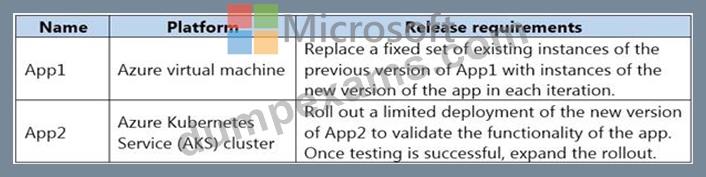
You need to configure the YAML strategy value for each app. The solution must minimize app downtime.
Which value should you configure for each app? To answer, select the appropriate options in the answer area.
NOTE: Each correct selection is worth one point.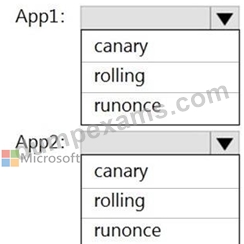
Answer:
Explanation: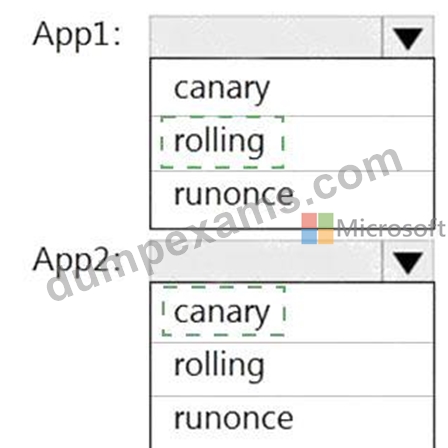
Explanation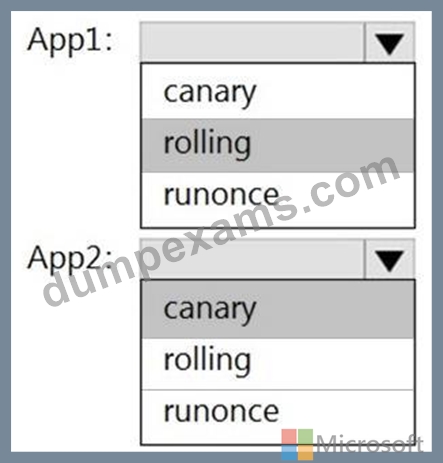
App1: rolling
A rolling deployment replaces instances of the previous version of an application with instances of the new version of the application on a fixed set of virtual machines (rolling set) in each iteration.
App2: canary
Canary deployment strategy is an advanced deployment strategy that helps mitigate the risk involved in rolling out new versions of applications. By using this strategy, you can roll out the changes to a small subset of servers first. As you gain more confidence in the new version, you can release it to more servers in your infrastructure and route more traffic to it.
Reference:
https://docs.microsoft.com/en-us/azure/devops/pipelines/process/deployment-jobs
NEW QUESTION # 337
Note: This question is part of a series of questions that present the same scenario. Each question in the series contains a unique solution that might meet the stated goals. Some question sets might have more than one correct solution, while others might not have a correct solution.
After you answer a question in this section, you will NOT be able to return to it. As a result, these questions will not appear in the review screen.
You use Azure Pipelines to build and test a React.js application.
You have a pipeline that has a single job.
You discover that installing JavaScript packages from 9pm takes approximately five minutes each time you run the pipeline.
You need to recommend a solution to reduce the pipeline execution time.
Solution: You recommend using pipeline artifacts.
Does this meet the goal?
- A. Yes
- B. No
Answer: B
Explanation:
Pipeline artifacts are a way to persist build outputs, test results, and other files generated during a pipeline run.
They allow you to share data between stages, jobs, and pipelines, and to persist data for longer than the lifetime of a pipeline run. While artifacts can be useful for sharing data between pipeline runs and reducing the time required to download dependencies, they are not a solution for reducing the time required to install JavaScript packages from 9pm during a pipeline run.
The solution of reducing the pipeline execution time could be achieved by using package caching, which allows you to store and reuse 9pm packages from previous pipeline runs. There are several package caching options available for Azure Pipelines, including the 9pm task, the 9pm cache task, and the 9pm ci task. All of these options allow you to configure caching for your 9pm packages, which can significantly reduce the time required to install packages during subsequent pipeline runs.
Another solution could be using a dedicated agent that has those packages already installed, this way the pipeline doesn't have to install them again.
You can find more information on package caching by following this link https://docs.microsoft.com/en-us
/azure/devops/pipelines/tasks/package/npm-cache?view=azure-devops
NEW QUESTION # 338 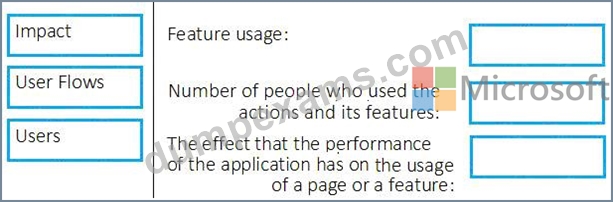
Your company wants to use Azure Application Insights to understand how user behaviors affect an application.
Which Application Insights tool should you use to analyze each behavior? To answer, drag the appropriate tools to the correct behaviors. Each tool may be used once, more than once, or not at all. You may need to drag the split bar between panes or scroll to view content.
NOTE: Each correct selection is worth one point.
Answer:
Explanation: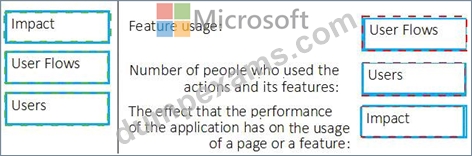
Explanation:
Box 1: User Flows
The User Flows tool visualizes how users navigate between the pages and features of your site. It's great for answering questions like:
How do users navigate away from a page on your site?
What do users click on a page on your site?
Where are the places that users churn most from your site?
Are there places where users repeat the same action over and over?
Box 2: Users
Counting Users: The user behavior analytics tools don't currently support counting users or sessions based on properties other than anonymous user ID, authenticated user ID, or session ID.
Box 3: Impact
Impact analyzes how load times and other properties influence conversion rates for various parts of your app.
To put it more precisely, it discovers how any dimension of a page view, custom event, or request affects the usage of a different page view or custom event.
Reference:
https://docs.microsoft.com/en-us/azure/azure-monitor/app/usage-flows
https://docs.microsoft.com/en-us/azure/azure-monitor/app/usage-impact
https://docs.microsoft.com/en-us/azure/azure-monitor/app/usage-troubleshoot
NEW QUESTION # 339
Which package feed access levels should be assigned to the Developers and Team Leaders groups for the investment planning applications suite? To answer, drag the appropriate access levels to the correct groups.
Each access level may be used once, more than once, or not at all. You may need to drag the split bar between panes or scroll to view content.
NOTE: Each correct selection is worth one point.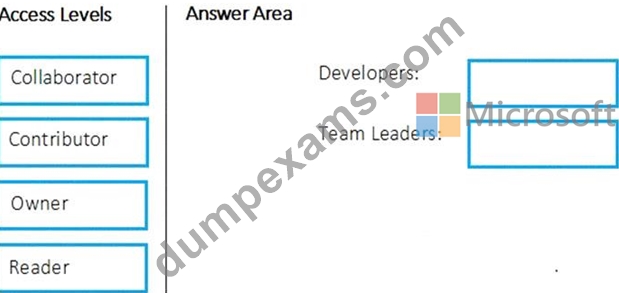
Answer:
Explanation: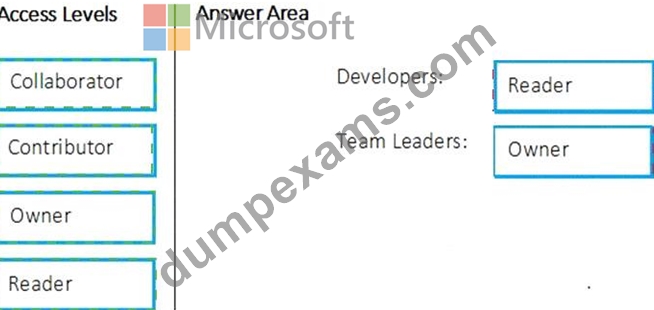
Explanation: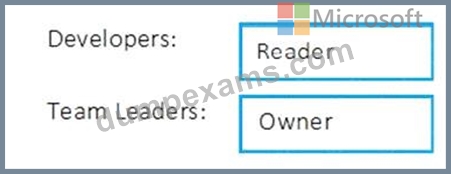
Box 1: Reader
Members of a group named Developers must be able to install packages.
Feeds have four levels of access: Owners, Contributors, Collaborators, and Readers. Owners can add any type of identity-individuals, teams, and groups-to any access level.
Box 2: Owner
Members of a group named Team Leaders must be able to create new packages and edit the permissions of package feeds.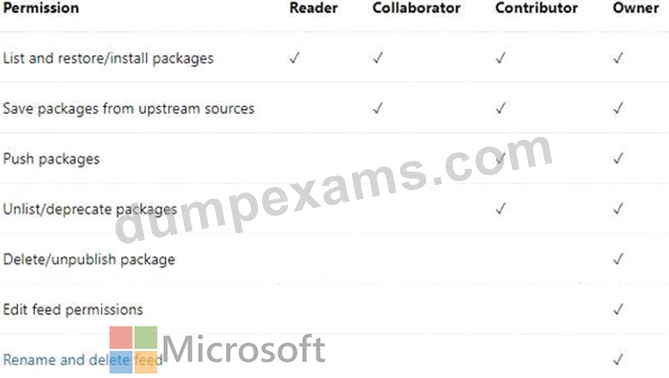
NEW QUESTION # 340
Your company uses a Git repository in Azure Repos lo manage the source code of a web application. The master branch is protected from direct updates. Developers work on new features in the topic branches.
Because of the high volume of requested features, it is difficult to follow the history of the changes to the master branch.
You need to enforce a pull request merge strategy. The strategy must meet the following requirements:
* Consolidate commit histories
* Merge tie changes into a tingle commit
Which merge strategy should you use in the branch policy?
- A. Git fetch
- B. fast-forward merge
- C. squash merge
- D. no-fast-forward merge
Answer: C
Explanation:
Squash merging is a merge option that allows you to condense the Git history of topic branches when you complete a pull request. Instead of each commit on the topic branch being added to the history of the default branch, a squash merge takes all the file changes and adds them to a single new commit on the default branch.
A simple way to think about this is that squash merge gives you just the file changes, and a regular merge gives you the file changes and the commit history.
Note: Squash merging keeps your default branch histories clean and easy to follow without demanding any workflow changes on your team. Contributors to the topic branch work how they want in the topic branch, and the default branches keep a linear history through the use of squash merges. The commit history of a master branch updated with squash merges will have one commit for each merged branch. You can step through this history commit by commit to find out exactly when work was done.
References: https://docs.microsoft.com/en-us/azure/devops/repos/git/merging-with-squash
NEW QUESTION # 341
You have a containerized solution that runs in Azure Container Instances. The solution contains a frontend container named App1 and a backend container named DB1. DB1 loads a large amount of data during startup.
You need to verify that DB1 can handle incoming requests before users can submit requests to Appl.
What should you configure?
- A. a readiness probe
- B. an Azure Load Balancer health probe
- C. a performance log
- D. a Iiveness probe
Answer: A
Explanation:
Explanation
For containerized applications that serve traffic, you might want to verify that your container is ready to handle incoming requests. Azure Container Instances supports readiness probes to include configurations so that your container can't be accessed under certain conditions.
Reference:
https://docs.microsoft.com/en-us/azure/container-instances/container-instances-readiness-probe
NEW QUESTION # 342
You have a project in Azure DevOps named Project1. Project! contains a pipeline that builds a container image named Image! and pushes Image1 to an Azure container registry named ACR1. Image! uses a base image stored in Docker Hub.
You need to ensure that Image1 is updated automatically whenever the base image is updated.
What should you do?
- A. Enable the Azure Event Grid resource provider and subscribe to registry events.
- B. Create a service hook in Project1.
- C. Add a Docker Hub service connection to Azure Pipelines.
- D. Create and run an Azure Container Registry task.
Answer: D
Explanation:
Explanation
ACR Tasks supports automated container image builds when a container's base image is updated, such as when you patch the OS or application framework in one of your base images.
Reference:
https://docs.microsoft.com/en-us/azure/container-registry/container-registry-tutorial-base-image-update
NEW QUESTION # 343
SIMULATION
You need to prepare a network security group (NSG) named az400-9940427-nsg1 to host an Azure DevOps pipeline agent. The solution must allow only the required outbound port for Azure DevOps and deny all other inbound and outbound access to the Internet.
To complete this task, sign in to the Microsoft Azure portal.
- A. 1. Open Microsoft Azure Portal and Log into your Azure account.
2. Select network security group (NSG) named az400-9940427-nsg1
3. Select Settings, Outbound security rules, and click Add
4. Click Advanced
5. Change the following settings:
* Destination Port range: 8080
* Protocol. TCP
* Action: Allow
Note: By default, Azure DevOps Server uses TCP Port 8080. - B. 1. Open Microsoft Azure Portal and Log into your Azure account.
2. Select network security group (NSG) named az400-9940427-nsg1
3. Select Settings, Outbound security rules, and click Add
4. Click Advanced
5. Change the following settings:
* Destination Port range: 9090
* Protocol. TCP
* Action: Allow
Note: By default, Azure DevOps Server uses TCP Port 8080.
Answer: A
Explanation:
References:
https://robertsmit.wordpress.com/2017/09/11/step-by-step-azure-network-security-groups-nsg-security-center-azure-nsg-network/
https://docs.microsoft.com/en-us/azure/devops/server/architecture/required-ports?view=azure-devops
NEW QUESTION # 344
You have an Azure DevOps project named Project1 and an Azure subscription named Sub1. Sub1 contains an Azure SQL database named DB1.
You need to create a release pipeline that uses the Azure SQL Database Deployment task to update DB1.
Which artifact should you deploy?
- A. a DACPAC
- B. an MDF file
- C. a BACPAC
- D. an LDF file
Answer: A
Explanation:
Explanation
Explanation:
Use Azure SQL Database Deployment task in a build or release pipeline to deploy to Azure SQL DB using a DACPAC or run scripts using SQLCMD.
Reference:
https://docs.microsoft.com/en-us/azure/devops/pipelines/tasks/deploy/sql-azure-dacpac-deployment
NEW QUESTION # 345
You have an application that consists of several Azure App Service web apps and Azure functions.
You need to access the security of the web apps and the functions.
Which Azure features can you use to provide a recommendation for the security of the application?
- A. Security & Compliance in Azure Log Analytics
- B. Compute & apps inAzure Security Center
- C. Resource health in Azure Service Health
- D. Smart Detection in Azure Application Insights
Answer: B
Explanation:
Monitor compute and app services: Compute & apps include the App Services tab, which App services: list of your App service environments and current security state of each.
Recommendations
This section has aset of recommendations for each VM and computer, web and worker roles, Azure App Service Web Apps, and Azure App Service Environment that Security Center monitors. The first column lists the recommendation. The second column shows the total number of resources that are affected by that recommendation. The third column shows the severity of the issue.
References:
https://docs.microsoft.com/en-us/azure/azure-monitor/app/proactive-diagnostics
NEW QUESTION # 346
You are designing YAML-based Azure pipelines for the apps shown in the following table.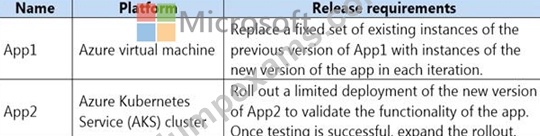
You need to configure the YAML strategy value for each app. The solution must minimize app downtime.
Which value should you configure for each app? To answer, select the appropriate options in the answer area.
NOTE: Each correct selection is worth one point.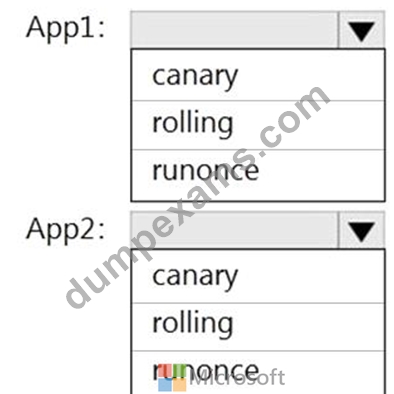
Answer:
Explanation: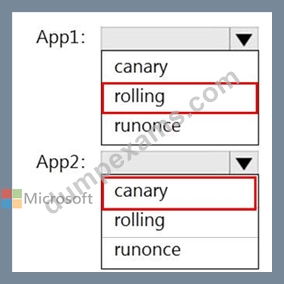
Reference:
https://docs.microsoft.com/en-us/azure/devops/pipelines/process/deployment-jobs
NEW QUESTION # 347
You need to increase the security of your team's development process.
Which type of security tool should you recommend for each stage of the development process? To answer, drag the appropriate security toots to the correct stages. Each security tool may be used once, more than once, or not at all. You may need to drag the split bar between panes or scroll to view content NOTE: Each correct selection is worth one point.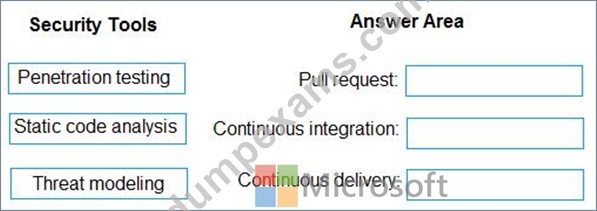
Answer:
Explanation: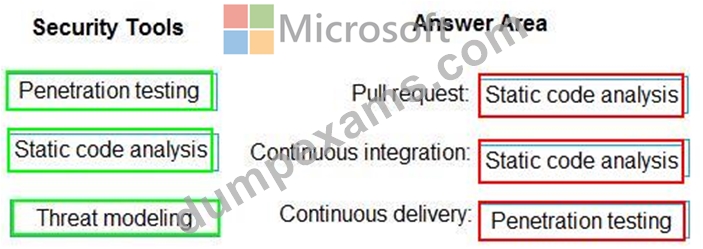
NEW QUESTION # 348
You are finalizing a release in GitHub.
You need to apply the following labels to the release:
* Name
* Email
* Release v3.0
* Release date
How should you complete the git command? To answer, select the appropriate options in the answer area.
NOTE: Each correct selection is worth one point.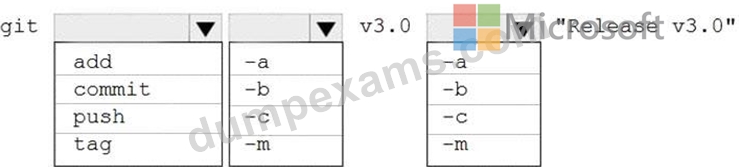
Answer:
Explanation: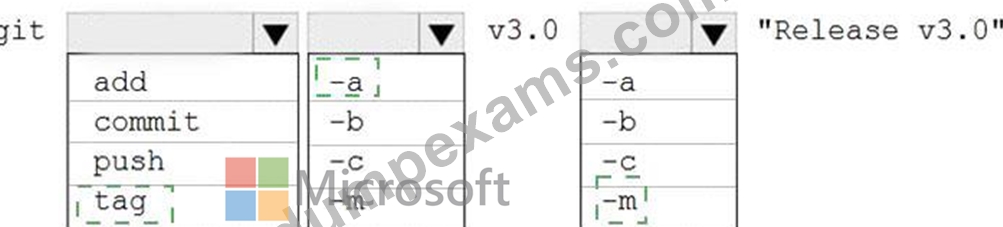
Explanation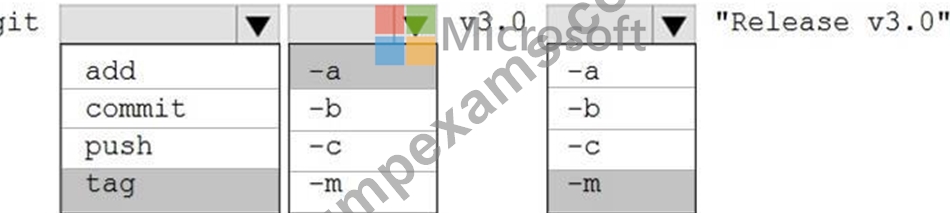
Box 1; tag
Tagging. Like most VCSs, Git has the ability to tag specific points in a repository's history as being important.
Typically, people use this functionality to mark release points (v1.0, v2.0 and so on).
Box 2: -a
Creating an annotated tag in Git is simple. The easiest way is to specify -a when you run the tag command:
Example:
$ git tag -a v1.4 -m "my version 1.4"
Box 3: -m
Reference:
https://git-scm.com/book/en/v2/Git-Basics-Tagging
NEW QUESTION # 349
You have a project in Azure DevOps that contains a release pipeline. The pipeline contains two stages named QA and Prod. QA deploys code to an Azure webapp named webapp1. Prod deploys code to an Azure web app named webapp2.
You need to ensure that code deployments to webapp2 are blocked if Azure Application Insights generates Failed requests alerts following the deployment of new code to webapp1.
What should you do for each stage? To answer, select the appropriate options in the answer area.
NOTE: Each correct selection is worth one point.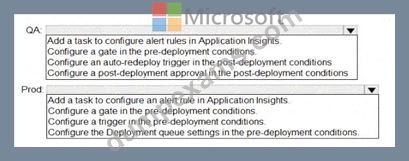
Answer:
Explanation: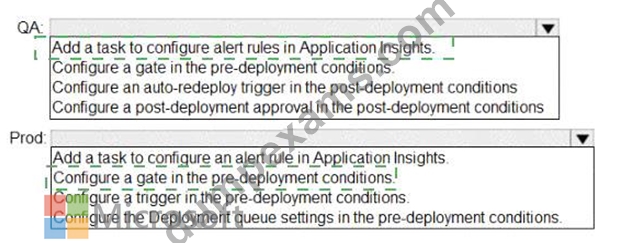
NEW QUESTION # 350
You plan to use Desired State Configuration (DSC) to maintain the configuration state of virtual machines that run Windows Server.
You need to perform the following:
Install Internet Information Services (IIS) on the virtual machines.
Update the default home page of the IIS web server.
How should you configure the DSC configuration file? To answer, select the appropriate options in the answer area.
NOTE: Each correct selection is worth one point.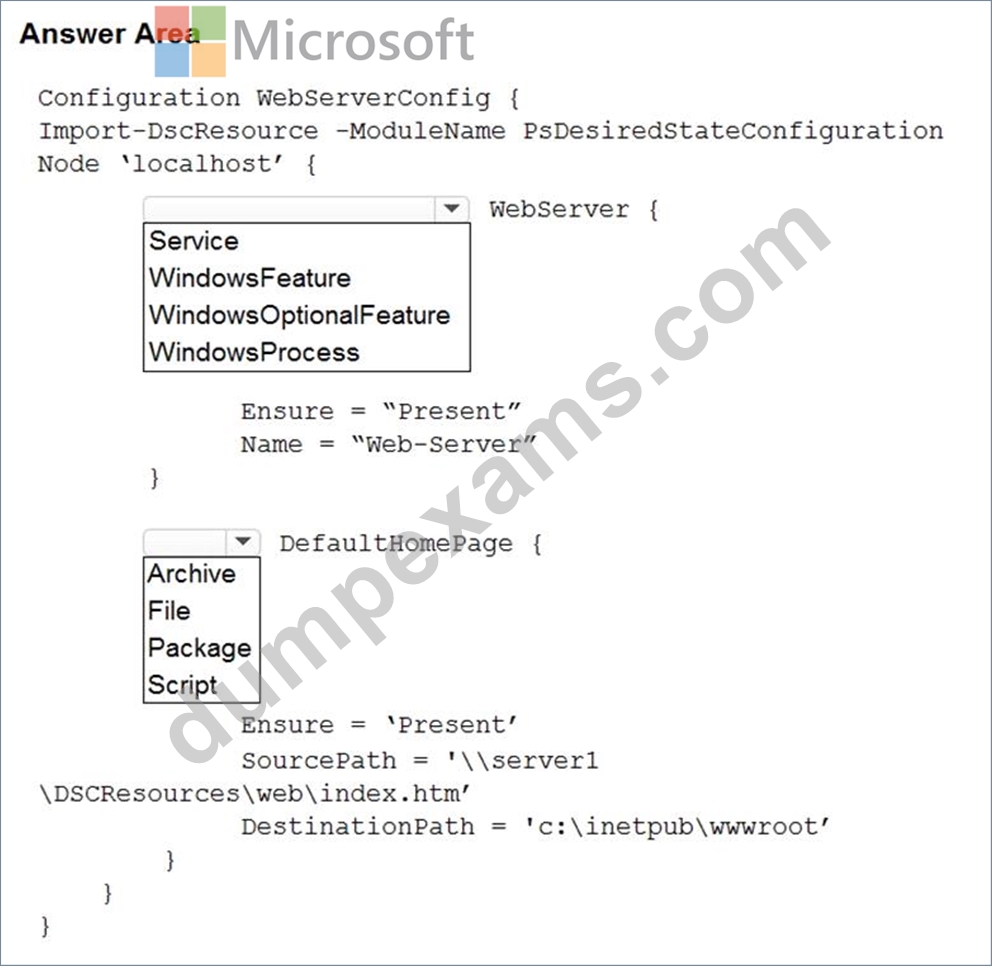
Answer:
Explanation: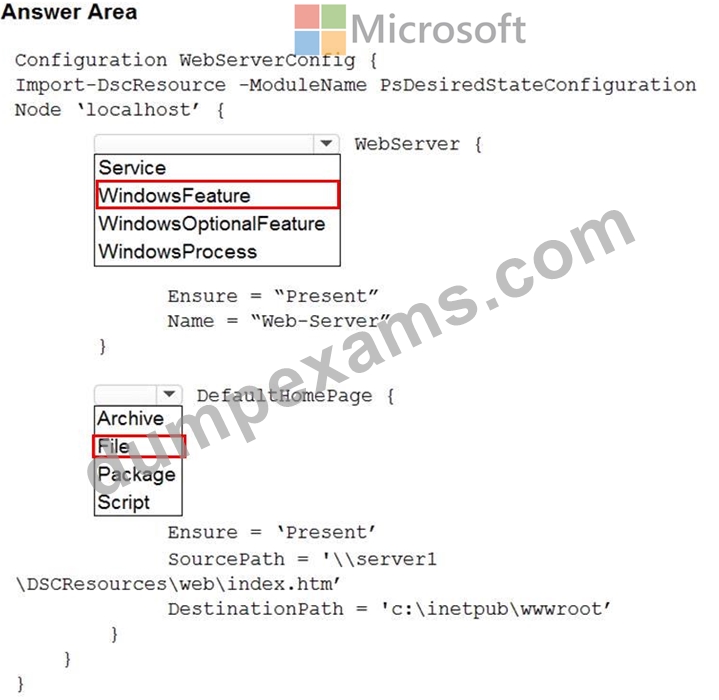
Reference:
https://docs.microsoft.com/en-us/powershell/scripting/dsc/quickstarts/website-quickstart
NEW QUESTION # 351
Note: This question is part of a series of questions that present the same scenario. Each question in the series contains a unique solution that might meet the stated goals. Some question sets might have more than one correct solution, while others might not have a correct solution.
After you answer a question in this section, you will NOT be able to return to it. As a result, these questions will not appear in the review screen.
You have an approval process that contains a condition. The condition requires that releases be approved by a team leader before they are deployed.
You have a policy stating that approvals must occur within eight hours.
You discover that deployment fail if the approvals take longer than two hours.
You need to ensure that the deployments only fail if the approvals take longer than eight hours.
Solution: From Pre-deployment conditions, you modify the Time between re-evaluation of gates option.
Does this meet the goal?
- A. No
- B. Yes
Answer: B
Explanation:
Explanation
Gates allow automatic collection of health signals from external services, and then promote the release when all the signals are successful at the same time or stop the deployment on timeout. Typically, gates are used in connection with incident management, problem management, change management, monitoring, and external approval systems.
References: https://docs.microsoft.com/en-us/azure/devops/pipelines/release/approvals/gates Approvals and gates give you additional control over the start and completion of the deployment pipeline.
Each stage in a release pipeline can be configured with pre-deployment and post-deployment conditions that can include waiting for users to manually approve or reject deployments, and checking with other automated systems until specific conditions are verified.
NEW QUESTION # 352
You are developing a full Microsoft .NET Framework solution that includes unit tests.
You need to configure SonarQube to perform a code quality validation of the C# code as part of the build pipelines.
Which four tasks should you perform in sequence? To answer, move the appropriate tasks from the list of tasks to the answer area and arrange them in the correct order.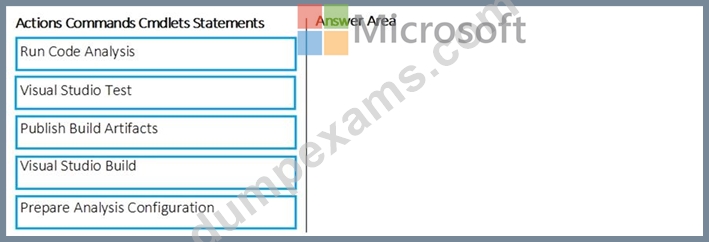
Answer:
Explanation: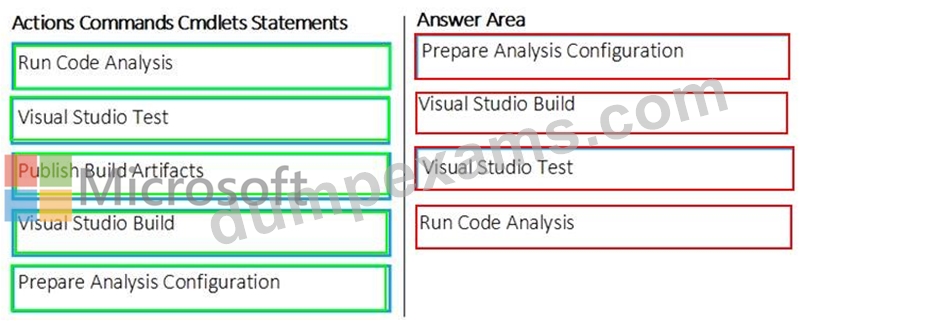
NEW QUESTION # 353
Your company has four projects. The version control requirements for each project are shown in the following table.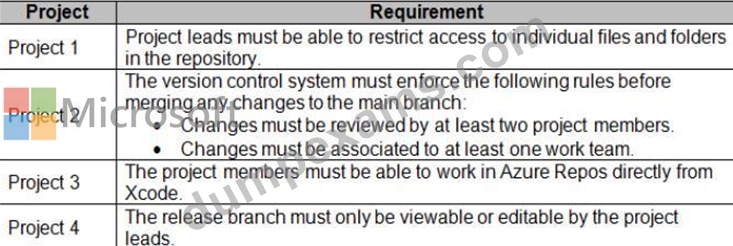
You plan to use Azure Repos for all the projects.
Which version control system should you use for each project? To answer, drag the appropriate version control systems to the correct projects. Each version control system may be used once, more than once, or not at all.
You may need to drag the split bar between panes or scroll to view content.
NOTE: Each correct selection is worth one point.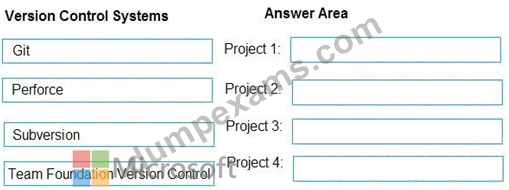
Answer:
Explanation: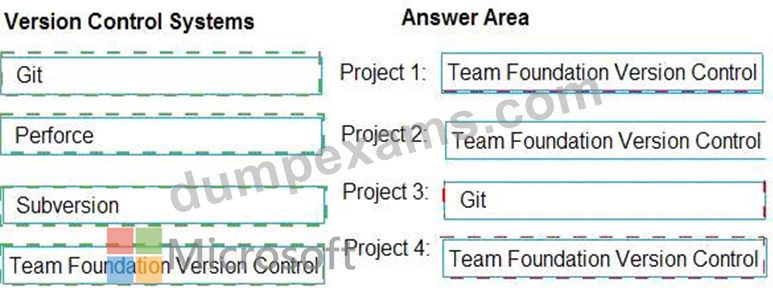
Explanation
1 -> TFVS Refer :
https://docs.microsoft.com/en-us/azure/devops/repos/tfvc/control-access-team-foundation-version-control?view=
2 -> TFVS Refer :
https://docs.microsoft.com/en-us/azure/devops/repos/tfvc/add-check-policies?view=azure-devops
3 -> Git Refer :
https://docs.microsoft.com/en-us/azure/devops/repos/git/share-your-code-in-git-xcode?view=azure-devops
4 -> TFVS Refer
:https://docs.microsoft.com/en-us/azure/devops/organizations/security/permissions?view=azure-devops#tfvc
NEW QUESTION # 354
......
AZ-400 dumps Exam Material with 564 Questions: https://prep4sure.dumpexams.com/AZ-400-vce-torrent.html